July 28, 2026 | Paul Avery, Supreme Group
Get Real: How Pharma Brands Can Earn Trust in 2026
How can a pharma brand earn the attention and trust of patients, physicians and other stakeholders in an industry filled with skepticism, AI generated noise and an overwhelming array of media channels?
To help answer this question, I sat down with Nicky Battle, President of Supreme Communications, where we discussed why pharma brands need unpolished honesty and transparency to cut through and build credibility in 2026.
Read on for an edited Q&A of our conversation, or watch the episode in full above, on Spotify, Apple Podcasts, YouTube, or wherever you get your podcasts.
The Trust Deficit in Pharma
Paul: What is it about the need to build trust that’s so important in pharma marketing, specifically?
Nicky: Trust in the accuracy and quality of information provided by pharma organizations has always been important, so that patients and physicians have the confidence and clarity they need to make critical healthcare decisions.
But today, we also have to contend with broader macro issues around trust and credibility. With the increased prevalence of AI-generated content and fake news, it’s increasingly hard for people to know what to believe. Most people now start from a default position of skepticism and that’s why earning trust has never been more critical for pharma organizations.
Paul: In life sciences, healthcare, and pharma, what do you think are the downstream ramifications of not doing PR and communications well?
Nicky: We’re seeing it already. “Big Pharma” is seen as quite negative, even though our sector is the source of so much innovation that helps save and improve lives. People want medicine to help fix them, and yet there’s often a big disconnect between trust in the medicine and trust in the company.
Nike is a good non-healthcare example that pharma should pay attention to. They’ve lost a lot of market share recently, despite once being the dominant sportswear brand. A lot of it is down to a growing disconnect with young consumers and not understanding that community.
In pharma, we’ve got giants in this space who’ve had massive success with blockbuster treatments, backed by some really best-in-class marketing and promotion, but things can change quickly.
Just because you have the data and the market share today doesn’t mean you will always have the legacy. You have to take care of your corporate reputation at a community level and not just focus on product launches.
Paul: What do you recommend to a company tackling the broader mistrust in pharma?
Nicky: To build trust you need to be visible in the patient community and you also need to listen. You need to make sure that you are actually reflecting back what’s happening in the space and the language that people are using to talk about their experience.
We have access to phenomenal amounts of data right now and Supreme Group’s AI platform Supreme Intelligence gives us important insights to help us create and test outputs. However, that traditional human connection, speaking with people and understanding what they’re facing, is also still critical for organizations.
Building Trust with Authenticity and Truth, While Remaining Compliant
Paul: What are some of the biggest communication problems pharma companies are facing right now?
Nicky: One of our biggest communications problems in pharma is that we sanitize everything. We like a nice, polished physician — crisp polo shirt, khakis, stethoscope, smiling — and we try hard to make it all look neat and tidy. But the truth is, people just want to see their life reflected back to them to show we understand them. The brands that are starting to do that are the ones reaping the benefits, because they’re forming a connection with their audience.
Paul: So, do you feel that there’s a bit of a movement towards more authenticity?
Nicky: Increasingly, yes. This last Super Bowl had eleven healthcare ads and the storytelling felt much more real than it had previously. The production budgets are still enormous, of course, but it felt more gritty, there’s a lot less of that shiny, everyone-in-the-same-three-colors look. Instead we got real vignettes of life happening, the sad parts included.
Paul: Related to this is the concept of truth in communications. What does that mean to you and what does it look like in practice?
Nicky: It’s about an almost absurd amount of transparency. Providing physicians not just with the three highlights of what they can expect from this particular treatment, but actually providing open-source access to all of the data. We have seen a couple of brands do this on their websites. You can do batch downloads of every single study, all of the data, so that you can dig in on your own.
As a more general example, when you are shopping on a website and you see that every review is positive, you know or assume that editing has happened, and that alone can make you distrust the brand. I always feel much better and more trusting when it’s not just 5* reviews on the website. Knowing that I can filter through and see all the one-star reviews and read through and say, “Hmm, would that be my experience? Maybe not.” That’s the level of transparency required for people to trust.
Paul: What are the Dos and Don’ts that you recommend in order to balance staying compliant with regulations while also being authentic and ‘real’?
Nicky: Balancing compliance with authentic storytelling is undoubtedly a huge challenge, particularly given the tightening FDA regulations, but it is possible. Experienced teams like ours have learned where the ‘Goldilocks’ zone is, when you can lean into authenticity, while still being confident about compliance.
For example, if we’re announcing data being released at a conference, we have very strict guidelines about what we can say. But there are so many ways to get people excited about what’s coming that feel far more authentic and natural than a guarded, corporate LinkedIn post.
We can share disease-awareness and educational content that primes the community to understand why the upcoming data matters. We can also spotlight patient and caregiver stories about living with the condition, or take people behind the science to meet the researchers and understand the years of work leading to this moment.
And rather than a one-way communication, we work with patient advocacy groups in advance and co-plan the moment together.
That kind of engagement builds real connection around the disease area, so that when the data is ready, the community is already invested and trusts the brand.
Paul: How do you coach reluctant clients on the value of a more transparent and authentic approach and get them to buy in?
Nicky: We’re so lucky at Supreme Communications that many of our clients are gladiators, and they’re ready to go to task and say, “This is the message that will resonate. We’ve done the testing. We’ve got the data. We’ve got a whole community and stakeholders that have signed off on this. Let’s go.”
It takes a person who’s not afraid to defend the point and of course we’re right there alongside them. That is always where the best work comes from.
I also think we’re more likely to have gladiators because of the nature of the work we do. That personal “why” story often runs deep. Someone is either struggling with that particular condition themselves, or often it is someone in their family or friendship group. Working in healthcare is personal for most people.
Earning Permission With Strategic Communications in Pharma
Paul: When you’re thinking about strategic communications in life science, healthcare, and pharma, what does that actually mean to you?
Nicky: I love this question because I think that PR has a PR problem, and some folks really don’t understand the space. Because of this, I’ve started talking about strategic communications in terms of permission. When you do strategic communications well, you’re earning permission to become a trusted voice and take the lead. The majority of our clients want to be that category leader, so our job is to maximize the amount of permission they have in the space.
To do this well, you need a simple and true story, because it’s that truth factor that’s really resonating and breaking through right now. The story should also put the needs of the customer or patient at the heart and position your solution from their point of view.
When it comes to earning permission, it’s also important to make sure you’re showing up in the spaces and with the voices that the community trusts. That sounds simple, but it can be a challenge and not all organizations do this. Some companies focus on older playbooks that just aren’t relevant today.
Why the Old Playbook Falls Short
Paul: What would you consider part of the older playbook that’s not quite as good a fit today?
Nicky: Many companies still use the PESO framework as a default, implementing integrated campaigns across paid, earned, shared, and owned media channels. The risk of this is that it just turns into a volume of work that isn’t always needed and doesn’t necessarily break through.
I would challenge companies to ask themselves: what channels and topics can we actually own in this space that will make the most impact? It might be that PESO is the right approach but sometimes that’s not the case. That’s where our AI audits and tools have been remarkable, because we can find that out at the snap of a finger and then help build a customized plan for our clients.
The old way is also milestone-driven using a fixed one year plan, with little room for flexibility. Planning and anchoring to milestones is important but we also need flexibility to adapt as things change and we need to be showing up consistently, all the time, not just at specific events.
Paul: Why are frequency and consistency so important in today’s media landscape?
Nicky: We used to talk a lot about the five or seven touches needed in marketing, but now at Supreme we joke it’s more like 7,000 touches. We just have so much media to contend with and people’s attention spans are often short. I’m one of those people who can work on a presentation at night, watch a television show, and also be on X, all at the same time and I think that’s typical of many people.
So for your message to penetrate and get through, you really need your content to be seen frequently across multiple touch points at a bare minimum. And if a piece of content does break through and make an impact, despite all of the many distractions of life and today’s media, you know it must have been good. Usually, for me, it’s when it’s so truthful and human that it’s almost breathtaking.
Evolving the Pharma Launch
Paul: Traditional launches are one big announcement, a burst of media, then a slow drip. How do you think that strategy needs to evolve, given where we are today?
Nicky: I think this all goes back to the fixed annual plan. One of the things that we do is, at minimum, chop it up into quarters, because you have no idea what’s going to happen over a quarter until you get there. Obviously, you can forecast, and that’s something we do well, but we really want to make sure that we are being adaptable and listening to what the market actually needs. If you set it and forget it with an annual plan, I guarantee that you won’t actually hit your KPIs because the world is changing too fast.
Paul: Beyond adjusting the plan itself, what new tactics are you using to keep a launch alive?
Nicky: A cool thing we’ve been doing lately is live demos. We do a good amount of health IT work, where clients need providers and the institutions buying their product to understand the benefit and differentiation of an upgrade. A traditional launch plan would just be differentiation stories and reasons to believe.
But we want to build real credibility in the space with the people who actually have to use it. So we’ve paired influencers or peers with our client’s executives to walk through a live demo. It feels real and in the moment, a genuine conversation, not a one-way piece of thought leadership or a commercial from the brand. And it can happen again and again. The more you do that in the mediums people trust, the better.
AI and the Rise of the Intelligence Layer
Paul: How is AI impacting how Supreme Group delivers strategic communications?
Nicky: I’ve seen many eras of PR, and framing AI as an evolution of operating systems is what really resonates with clients. Operating System 1 was our newsroom era. It was a one-directional push to journalists.
Operating System 2 was our integrated comms era, where communications started to look more like marketing, tailored by channel and audience. That increased the volume of work, but not necessarily the impact.
Then Operating System 3 was the performance era, where PR had to prove ROI in hard numbers.
But honestly, none of those iterations are good enough for where we are now. What we have in Supreme Intelligence, our AI platform, is Operating System 4, an intelligence layer at the core of everything we do in strategic communications.
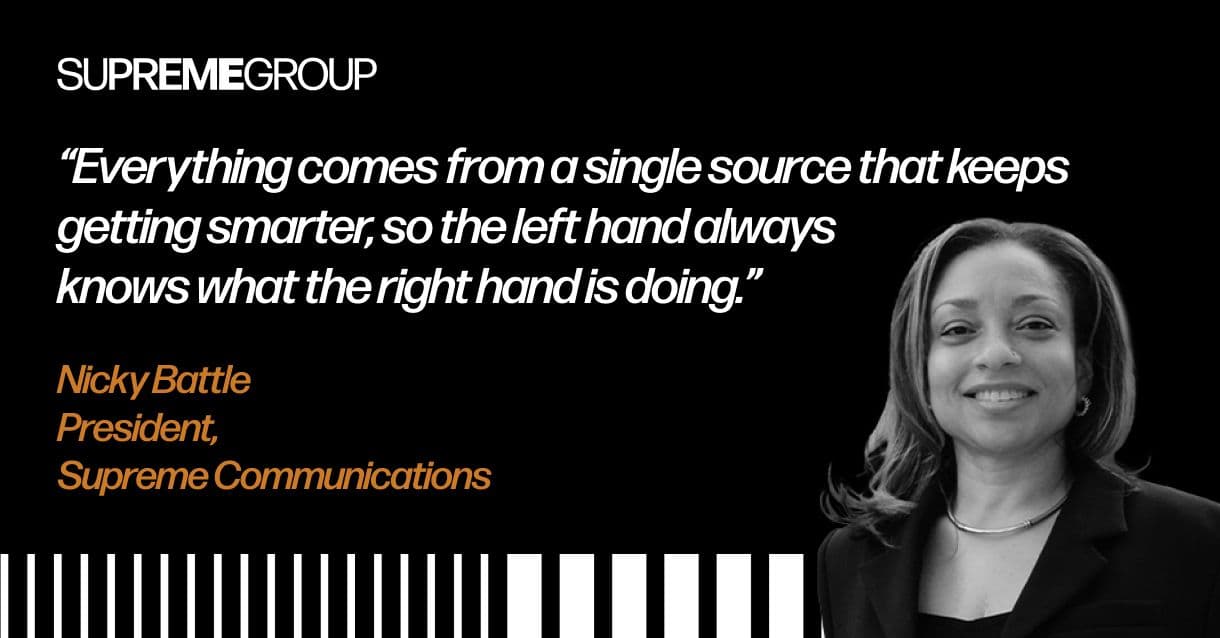
Everything comes from a single, smart source that keeps getting smarter. It means you never lose sight of which message resonates with which audience on which channel, and you never have to worry about the left hand not knowing what the right hand is doing. Every piece of content we create is powered by this operating system and one source of truth, so messaging is always consistent across every channel, at scale.
Paul: Can you give an example of how you’re using Supreme Intelligence for your clients?
Nicky: We recently built a thought leadership mapping tool where you can click on a thought leadership pillar, and it identifies the thought leaders, internal and external, who fit, because it resonates with their personal story, and we already know how they perform on podcasts.
Then it selects the publications where that message will most likely be picked up. So it matches the message to the messenger to the medium, and it’s agentic, so it drafts the first version of the pitch. The team fell in love with it. These tools make it so much easier to be in far more places than those original seven touches, which just isn’t enough anymore.
What’s even better is that, as we record how thought leadership campaigns perform and capture those results within Supreme Intelligence, the tool will continue to iterate and refine recommendations based on that data.
The Key Takeaways From Our Conversation
Trust in pharma isn’t won with polish in 2026, it’s earned through consistent authenticity and transparency. For brands ready to make that shift, here’s what it looks like in practice:
- Lead with a simple, true story. Put your target audience at the heart of it, not the product.
- Trade milestone-based presence for continuous presence. Show up consistently across multiple touchpoints rather than going quiet between big moments.
- Co-create your thought leadership. Build it through community listening and collaboration.
- Be transparent with your data. Invite scrutiny rather than avoid it. Transparency is what earns credibility.
- Plan in quarters, not years. Adapt your approach as the landscape and your community shift.
- Govern your messaging with AI. Keep it consistent across every audience, channel, and spokesperson from a single, intelligent source.
Want to hear the full conversation? You can find it on Spotify, Apple Podcasts, YouTube, or wherever you get your podcasts.

