June 16, 2026 | Paul Avery, EVP AI Adoption, Supreme Group
What the Forward-Deployed Engineering Model Means for Life Sciences and Healthcare Marketing
Most enterprise AI pilots never make it into full scale deployment. The demo works, the room is impressed, and then the project quietly stalls. In healthcare and life sciences, where commercial challenges are pressing and regulatory requirements are restricting, the distance between a promising prototype and a functional tool is even wider.
On the latest episode of The Supreme Pod, I sat down with Sheldon Zhai, Founder and Chief AI Officer at Supreme Group, to discuss Supreme Intelligence FDE+, the forward-deployed expert service model we created to close the gap between fragile demos and robust enterprise-wide deployment. Sheldon has spent the past few years working alongside our teams, helping pharma and life science companies leverage AI to better reach their commercialization goals in near real time.
Two principal AI deployment problems kept resurfacing in our conversation. One was what it actually takes to move AI from a slide deck into a regulated commercial workflow. The other was how a life science or healthcare marketing team can separate a capable partner from just an exciting sounding pitch.
To learn more, watch the episode in full on Spotify, Apple Podcasts, or YouTube, or read on for a summary of our conversation.
The Pilot That Never Leaves the Lab
At this point, many life science and healthcare teams have experienced the “AI pilot problem” firsthand, but few realize how universal it is. “Lots of these pilots, when they try to do them internally, they fail,” Sheldon told me, pointing to the MIT State of AI in Business 2025 report. Despite $30 to $40 billion in enterprise investment in GenAI, the report found that 95% of organizations are getting zero return.
When I asked him why, he did not blame the technology. He blamed time. Staying current with AI’s rapidly expanding capabilities is close to a full-time job in itself, and most teams cannot carve that job out on top of the one they already have.
Follow that constraint and the familiar pilot failure starts to look inevitable. A team with no spare capacity develops its pilot the only way it can, off to the side of the business using limited resources, built on generic data, owned by someone whose calendar is already full. The demo might impress, but once it ends, nobody has the hours to wire the tool into real data and workflows, solve for the inevitable errors and edge cases, and ensure the pilot scales up to deliver tangible, lasting results.
The same MIT research shows what changes the odds. According to the authors, external partnerships saw double the success rate of internally driven programs, a gap the report attributes less to resources than to clear ownership. Buying software alone does not capture the advantage, because a tool still needs someone with the time, expertise and mandate to embed it. In Sheldon’s view, forward deployment is a model built around exactly that person, and it starts by changing who shows up to do the work.
“Forward-Deployed Engineer” vs “Forward-Deployed Expert”
A forward-deployed engineer is an outside specialist well versed in how AI can be leveraged to augment and support business processes. They work from inside your organization rather than handing over software and walking away.
The role is designed to answer the time problem directly. Staying current with the technology, leveraging your specific data and workflows, and carrying a project from demo to deployment becomes one person’s entire job instead of a side project, and that same person is accountable for the results. It also helps that this person has deep expertise in leveraging AI to drive better commercial outcomes.
Our team at Supreme Group has made one deliberate change to that role. “We call it forward-deployed experts,” Sheldon explained, “because the difference is, if I just gave a pharma company an AI engineer, good luck.”
An AI/software engineer dropped into a healthcare or life sciences commercial team with no context cannot judge which problems are worth solving, let alone how a solution would need to be designed to meet industry-specific constraints, such as medical, legal, and regulatory (MLR) review.
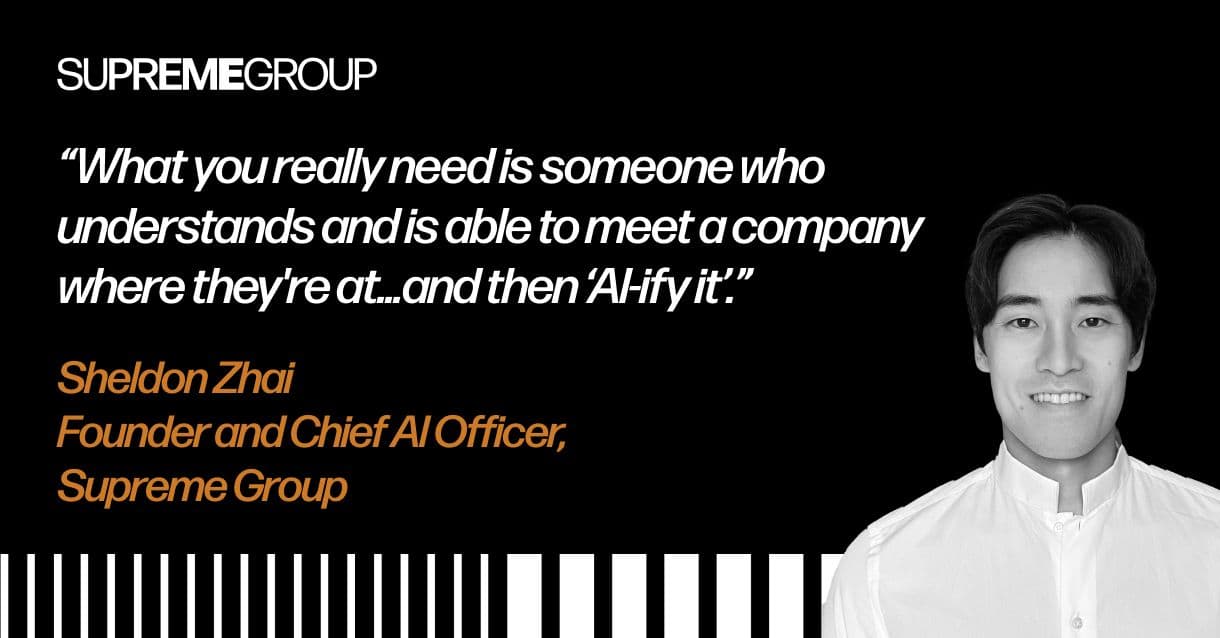
As Sheldon said, “What you really need is someone who understands and is able to meet a company where they’re at and then ‘AI-ify it’.”
In practice, for Supreme Group, that means bringing two capabilities together, sometimes in one person, but more often as a pair: a sector expert brings fluency in pharma, life sciences, and healthcare marketing, who then works with an AI solutions engineer that builds AI-driven tools and workflows once the right problem-solution is in focus.
The Nuances of Life Sciences and Healthcare Marketing
From what we’ve observed, generic AI deployment tends to break the moment it meets a regulated or complex commercial environment. For example, a healthcare marketing team cannot produce content the way a consumer brand can, because the work has to survive MLR review before it reaches a single physician or patient.
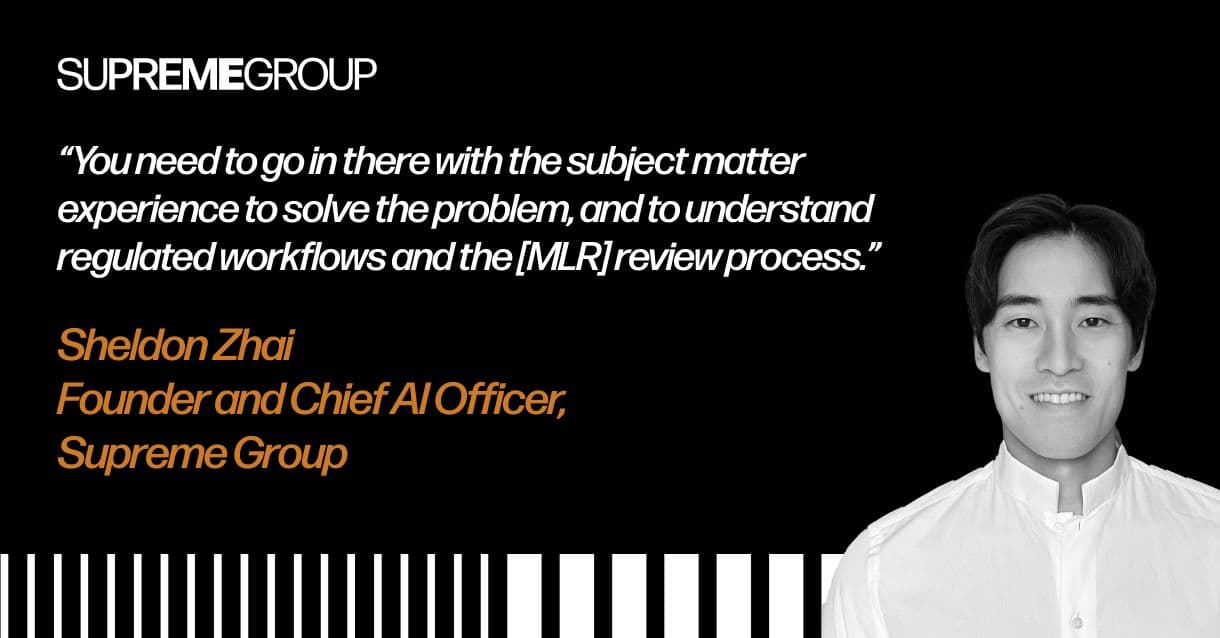
“You need to go in there with the subject matter experience to solve the problem, and to understand regulated workflows and the [MLR] review process,” Sheldon said, noting that review often routes through additional software systems like Veeva and that the path often changes by country.
Sector fluency, more than raw technical capability, separates the partners who can do this work well in our industry from those that can’t, and Sheldon was direct about how rare the right profile is. The people who can deliver the best results, he argued, “don’t exist at any other organization in the world, as far as I’m aware.”
The type of person Sheldon is talking about has often spent decades inside the pharma/life sciences ecosystem, understands the commercialization process end to end, and knows how a solution has to align with a client’s sector-specific nuances and restrictions. An outside AI firm can match the engineering talent, but the years spent learning directly inside the industry are far harder to replicate.
Diving a bit deeper, commercial experience is one half of that profile. Scientific depth is the other. More than 90 Supreme Group employees hold advanced degrees, including 65+ with PhDs, which means the people deploying AI in a given scientific or therapy area can engage with the underlying science rather than working from a brief they only partly understand. Sheldon described the pairing as “a one plus one equals 10 type of differentiation.”
For life science and healthcare marketing teams used to educating vendors who have never lived in their world, the difference shows up in the first working session. There is no need to waste time explaining what MLR review will and will not allow, why a claim cannot ship without a reference behind it, what “mechanism of action” means, and so on. Every explanation required adds friction, and friction is what stretches weeks into months. When the partner’s peer-level understanding is built in, the time goes into solving the real problems instead.
However, removing friction only saves some of the hours; it does not change what a partner can build with them. That depends on the second ingredient, a deep working knowledge of what AI is capable of right now. A team that knows the regulatory terrain but not the technology will still quote the industry standard. A team that knows the technology but not the terrain will not survive MLR review. The clearest proof of what happens when one team holds both is best demonstrated by a real project, which we’ll explore next.
The Five-Day Website
The project in question was a patient website, the likes of which cannot launch until legal and regulatory teams sign off on all the content (including messaging, copy, design, UX, etc.).
The client’s existing vendor had quoted the industry standard: three months and hundreds of thousands of dollars.
“Why don’t we do that for you, and we’ll do it for you in five days,” Sheldon recalled telling them. Supreme Group would also deliver the same site at 30 percent below the vendor’s quote.
The client’s own legal and regulatory team did not believe the offer was serious. “They were mind-blown,” Sheldon said. “They were like, honestly, we appreciate you trying, but there’s just zero chance.” Every round of client-driven feedback came back the same day, and the disbelief turned into excitement.
No corners were cut to hit the five days; every page still went through the client’s MLR reviewers. The pace came from the ability to build with AI at production quality, a capability that did not exist two years ago, when quoting three months for a compliant website was sound counsel. Our domain knowledge of pharma marketing and command of the regulatory process kept the build compliant at that pace, with every claim referenced and ready for MLR review.
The client has since handed Supreme Group the rest of the work on that account. Fast delivery in a regulated category still deserves scrutiny, because speed without control just means risky content goes live faster. One approved website proves the pace is possible. But making it repeatable and defensible to legal reviewers and security teams who have never met you requires reliable, trustworthy infrastructure that is built to deliver, project after project.
The Infrastructure That Makes the Speed Safe
Solving the infrastructure problem is the job of the “plus” in the FDE+ model. This is Supreme Intelligence: the software and AI layer underneath every engagement. Sheldon described it as a secure foundation that lets the team tap into curated AI models, knowledge, and data tailored to a specific company.
Commercialization in pharma runs far wider than content, across launch planning, brand strategy, HCP engagement, and analytics. The Supreme Intelligence foundation is built to serve whichever of those areas a team is working within.
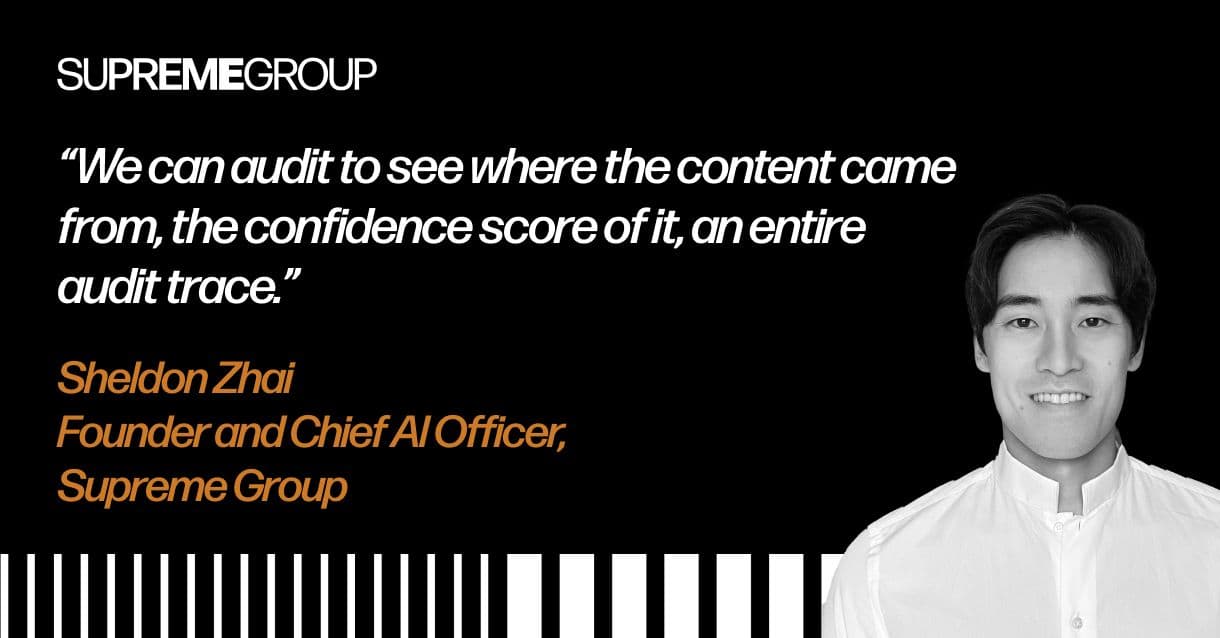
Arguably, content production offers the clearest example of where this expert plus infrastructure model delivers the most value, because it is where AI output meets MLR review head-on. “We can audit to see where the content came from, the confidence score of it, an entire audit trace,” Sheldon said.
That being said, an audit trail approves nothing on its own, and our expert reviewers still check every claim, but it answers the first question legal teams ask about AI-generated content, which is where the claims came from. When our work can clearly show its provenance, it can rapidly enter review with little to no friction. This is important as getting the content into review in a timely fashion is as important as the speed of generation.
However, client-side reviewers are only one audience that has to trust the system. Security and procurement teams are the other. For this reason, Supreme Intelligence has completed SOC 2 certification. Sheldon described this process as months of audits, background checks on every person, two-factor authentication across the board, and regular penetration testing. He has sat on big-pharma AI council calls, twenty people deep and asking sharp questions, and his read is that those conversations now go better than expected because the security teams are evaluating a solution built to be enterprise-ready rather than improvised.
Audit trails and SOC 2 reports answer one kind of question: whether the system can be trusted. But they cannot answer whether the work is any good, which is why humans still make up an important part of the process.
Where Humans Still Make the Difference in AI Deployment
Sheldon has a model demonstrating how important human experts are for delivering our FDE+ service. He calls it 20/60/20, and it describes where the effort lives. The first 20% is human; the strategy, insight, and judgment that set the goals and direction. AI can now execute the middle 60%, with most of this activity centered on production. The final 20% sees humans acting as taste-makers that “know what good looks like”, helping to ensure all AI outputs are high-quality and meet the brief. This last 20% also includes handling everything that touches the physical world, including managing the personal relationships and leveraging the in-person context that has not been captured by the AI system. He expects the middle 60% to keep widening as the tools improve, but that human experts will always be needed at the edges.
The split 20/60/20 measures effort, though, and Sheldon was careful to separate that from value. Humans “will probably add a very [significant] amount of the actual value, but they just won’t have to spend as much time doing the execution part,” he said. The human share of the effort shrinks. The human share of the impact does not.
Sheldon offered an example from his own late-night coding, an AI agent running for hours, steered by a single sentence of direction every so often. Those sentences carried most of the value, because they came from 20 years of knowing what good looks like.
The same argument tends to hold true in our client work. AI can produce a draft, but a technical writer, a brand and design team, and a commercial strategist are the ones who know whether the draft is good and meets the commercial requirements of the project, so that they can enhance and upgrade it as required before it goes near a client. The tools are raising the floor but the people still set the ceiling.
A business model that concentrates this much of the value in human judgment shifts what you are buying when you hire a life sciences and healthcare commercialization and marketing partner. More than ever, you are investing in access to industry experts who know what good looks like and have experience of what it takes to generate real results, so that they can set the direction and own the result. Their direction is only as sharp as their knowledge of your world, and only as trustworthy as the incentives behind it, which makes fluency and incentives the two things worth interrogating before you select a partner to help you deploy AI in your commercial organization.
Two Questions to Ask Any AI Partner
With the above in mind, fluency and incentives are both testable in a first meeting, and Sheldon’s advice condenses them into a question apiece. Whether you are a senior healthcare marketing executive, a commercial lead, or the person who owns AI decisions in a healthcare or life science business, the two questions below belong in every partner conversation.
The first question tests fluency.
Does this partner understand life science and healthcare, or only the AI side of the equation?
Fluency here means more than knowing the MLR review process. It means understanding how these markets work, who the audiences actually are, how a product moves from approval to adoption, and enough of the science to speak credibly about it to the scientists, healthcare professionals, payers, patients and other industry stakeholders who decide its fate.
A partner missing any of these elements will learn on your time and at your risk, and MLR review is where the learning gets the most expensive. The five-day website, and the bench of commercial and scientific experience behind it, is an example of what a strong answer looks like in practice – and Sheldon recommends teams push for a prototype or demonstration, not just a theoretical solution.
The second question tests incentives.
When this partner recommends an approach, whose interest does the recommendation serve?
The question has sharpened because the large AI labs now deploy their own engineers into enterprises, and those engineers arrive with a product to advance. “You’re inviting a Trojan horse,” Sheldon warned, “someone who’s highly biased to bring a specific AI model into your company, and giving them all of your data.” An engineer whose employer sells one suite of models will route every problem toward those models, and each routing deepens a dependency that gets harder to unwind.
Removing that bias was a design decision when building Supreme Intelligence, which is deliberately model agnostic, reaching for the best tool for each job. As Sheldon told me, “whether it’s Google’s best image generation model, ElevenLabs and their voice agents, Anthropic Claude for content, or Codex by OpenAI for programming. Our agenda is to deliver value.” A partner that makes its money by solving your problem, rather than by absorbing your workflow, keeps its recommendations and your interests pointed the same way.
This final argument lands back where this piece started, with pilots that impress a room but then go nowhere.
A pilot doesn’t fail because of the AI model. It stalls because nobody had time to carry it into the business, nobody knew the terrain well enough to aim it, and nothing underneath it could earn the trust of the people who needed to sign it off. Forward-deployed experts, with real infrastructure behind them and no model of their own to push, exist to remove those failure modes one by one.
Finally, what was true of the website project we discussed during our episode is true of the whole field. The capability of AI to deliver production quality at speed is already ahead of most organizations’ ability to use it, and the distance widens every month. Closing it is no longer a technology decision. It is a decision about who does the work. FDE+ is the answer we built to help you get results that stick and scale.
For more from Sheldon on the forward-deployed model and the thinking behind Supreme Intelligence FDE+, listen to the full episode of The Supreme Pod on Spotify, Apple Podcasts, or YouTube, and visit supremegroup.ai to learn more.

